
Need touch up paint for your VW but can’t find the paint code anywhere? You’re definitely not the only one!
Unlike many manufacturers, Volkswagen doesn’t always keep paint code information in the most obvious location, and the code itself can also be confusing if you don’t know what you’re looking for.
So to help you find your VW touch up paint code, we’ve put together the following guide with everything you need to know about VW paint codes, including where to find them, how to read them, and the most common Volkswagen colours on UK roads today. We’ll also explain why some VW colours are easier to touch up than others, and how to get the best results from your repair.
VW Paint Codes Explained
Most VW paint codes start with the letter “L”, which comes from the German word Lack, meaning paint.
Common examples include LA7W (Reflex Silver), LC9A (Pure White), and LY3D (Tornado Red).
To make matters slightly confusing, Volkswagen paint codes are sometimes shown without the “L” prefix. That means you might find LA7W listed as simply A7W on some paint websites or colour databases, which can make it look like a completely different colour code when it isn’t.
So if you’re searching for touch up paint and notice the “L” has been dropped, there’s no need to worry. The important part of the code is the remaining letters and numbers, as these identify the exact paint colour used on your Volkswagen.
Where to Find the VW Paint Code
Now that you know what the code itself looks like, the next step is actually finding your code in your vehicle.
Volkswagen stores the paint code on a white vehicle data sticker alongside other factory information, such as engine and transmission details. Depending on the model, there are a few places where that sticker is likely to be.
Boot Floor
For most VW models, including the Golf, Polo, Tiguan, Passat, and Jetta, the paint code sticker is usually found in the boot. All you have to do is lift the boot carpet or load liner and look around the spare wheel well, and the sticker is typically attached to the metal floor.
Service Book
If you still have the original service book or owner’s manual, this is often the easiest place to check. Volkswagen usually includes a duplicate of the vehicle data sticker inside the handbook, saving you from having to empty the boot.
Driver’s Door Shut
Some newer models, including the T-Roc, T-Cross and Touran, may have paint code information on the driver’s door Shut or B-pillar. If you drive a newer VW, it’s worth taking a quick look here first.
Engine Bay
Commercial vehicles such as the Transporter, Caddy and Amarok sometimes use a sticker or metal plate located under the bonnet. Check around the front cross member and surrounding panels.
No Sticker? Try a Registration Lookup
If the sticker has faded, been damaged by moisture, or the service book is missing, you can find your Volkswagen colour code by reg using the Chipex colour finder, which matches the registration to the factory paint record. Alternatively, a Volkswagen dealer can usually confirm the original paint code using your registration number or VIN.
Reading the VW Sticker and Finding the VW Paint Code Location
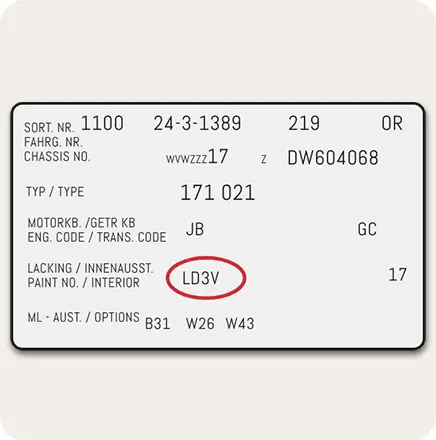
Once you’ve located the white data sticker, you’ll see a block of text and several different codes stacked together. This carries information about the engine, transmission, paint, and optional extras.
Again, the paint code is the entry that begins with an “L”. It often sits in the middle of the sticker, near the engine and transmission codes. Look for a three- or four-character sequence, such as LC9X or LB9A.
You may also notice another code printed alongside it. For example, some Volkswagen Group (VAG) vehicles display a code like 2Y2Y next to the main paint code. This is fairly common on Škoda and other VAG models that share production systems.
If you see multiple codes and aren’t sure which one to use, stick with the code that begins with “L”. That’s the manufacturer’s paint code and the one you’ll need when ordering VW touch up paint.
A Quick Note on the Shared VAG Palette
As part of the Volkswagen Group, VW shares many of its paint colours and paint codes with Audi, SEAT and Škoda.
For example, a code such as LC9X (Deep Black) is the same paint whether it’s applied to a VW Golf, an Audi A3 or a SEAT Leon. This can be useful when you’re trying to verify a paint code, as seeing it listed across multiple Volkswagen Group brands is often a good sign that you’ve found the right match.
The only thing to watch out for is the colour name. While the paint code stays the same, the marketing name can vary from one brand to another. Audi might use one name, while Škoda uses another, even though the paint itself is identical.
That’s why it’s always best to rely on the paint code rather than the colour name when ordering touch up paint. The code on your vehicle’s sticker is the most reliable way to identify the exact factory paint.
Common VW Touch Up Paint Colours in the UK
Volkswagen has produced hundreds of colours over the years, but a few iconic shades dominate the UK roads. The following table shows some of the most searched VW colours and their matching codes.
| Common VW Touch Up Paint Colours | |||
|---|---|---|---|
| Code | Name | Type | Notes |
| LC9A | Pure White | Solid | Common modern VW white |
| LC9X | Deep Black | Pearl | Popular modern VW black |
| LA7W | Reflex Silver | Metallic | Classic VW silver, several shades exist |
| LI7F | Urano Grey | Solid | Common modern Golf and Polo grey |
| LY3D | Tornado Red | Solid | Iconic VW red |
VW Golf, VW Polo and VW Tiguan Paint Code Tips
While Volkswagen uses the same paint code system across its range, there are a few model-specific quirks worth knowing.
-
- VW Golf: The Golf is one of the UK’s most popular cars, and later generations such as the Mk7 and Mk8 were offered in a much wider range of colours than earlier models, including more metallic and pearl finishes.
-
- VW Polo: The Polo follows the same paint code setup as the Golf, but older examples are more prone to damp around the spare wheel well. As a result, the boot sticker is often faded or missing, making the service book copy your best bet for finding your sticker and code.
-
- VW Tiguan: The Tiguan shares the same paint code locations but tends to feature a broader selection of modern colours, including many of Volkswagen’s premium pearl finishes.
-
- Performance Models: If you drive a GTI, R or other performance model, keep an eye out for exclusive colours such as Lapiz Blue (LD5K), which aren’t commonly found elsewhere in the VW range.
Finally, remember that the paint code only tells you the colour your VW left the factory with. On older used cars (especially Golfs and Polos), previous repairs or resprays can mean the paint on the vehicle no longer matches the original code exactly.
Understanding Your VW’s Paint Finish
Now that you know how to find and identify your VW paint code, it’s worth taking a quick look at the different paint finishes Volkswagen uses and what that means for your repair.
In our experience at Chipex, solid colours, like Tornado Red and Pure White, are generally the easiest to work with. They contain a single colour layer without any metallic flakes, making them simpler to apply and blend. For most DIY repairs, solid paints tend to deliver the most predictable results.
Metallic colours, such as Reflex Silver, contain tiny metallic particles that reflect light and give the paint its sparkle. Because these flakes need to sit evenly in the paint, application technique becomes more important. It’s also worth noting that colours like Reflex Silver have been produced in several variations over the years, making the correct paint code especially important.
Pearl finishes, such as Oryx White and Deep Black Pearl, are typically the most challenging to match. They contain special pigments that create a colour-shifting effect depending on the light and viewing angle. While they can still be repaired successfully at home, they tend to be less forgiving and benefit from a little extra patience during application.
For more guidance on repairing paint chips, scratches, and scuffs at home, you may find the following guides helpful:
Your Perfect Colour Match Starts With Chipex
We know it’s easy to get lost in a sea of codes, stickers, and colour names, but hopefully this guide has made finding and understanding your VW paint code a little less confusing.
When you’re ready to finally tackle those chips and scratches, Chipex has everything you need for a simple, stress-free repair at home. Find your perfect VW paint match and shop our beginner-friendly touch up kits today!
Search by using your Registration
Frequently Asked Questions About VW Touch Up Paint
Where is the paint code on a VW Golf?


Where is the paint code on a VW Polo?
What does a VW paint code look like?
Can I find my VW paint code from my registration?
Are VW and Audi paint codes the same?

Johnny Graham – Founder of Chipex
Johnny founded Chipex in 2009 and developed its patented paint repair system, now trusted by over 1.5 million customers worldwide. With nearly four decades at the premium end of the automotive industry, he remains closely involved in refining Chipex’s paint formulations and colour-matching technology.


