
Very successful car paint touch up starts with the right colour match.
However, if you own a Ford, you’ll already know that finding the right colour of Ford touch up paint is a lot easier said than done.
So to help you make sure you order the right match the first time, we’ve put together the following guide on how Ford colour codes work, where to find your code on your vehicle, and everything you need to know before ordering touch up paint.
Ford Paint Codes Explained
In general, Ford paint codes are usually much shorter compared to car paint codes used by other manufacturers like BMW or Audi.
On most modern UK Fords, the paint code is made up of just two characters, such as:
-
- Z3 (Frozen White)
-
- J7 (Magnetic Grey)
-
- PN (Panther Black)
Each Ford colour has one international code. That said, not every Ford code follows the exact same format. Some colours use a letter-and-number combination, such as 4E3 for Lightning Blue, while others, such as US-spec Fords, may appear as slightly longer variations like PN4AT or FRZWA.
It’s also worth noting that the paint code for the same colour can vary depending on where the vehicle was manufactured. For example, Lightning Blue may appear for your car as 4E3, but it can also be listed under alternative manufacturer references such as HCS, HCSEWHA, M7365A, N6, or PN4E3.
When in doubt, always check the paint code shown on your vehicle’s information sticker. If you’re not sure where that is, Ford paint codes are usually found on a small black information sticker attached somewhere on the vehicle. The paint field is often labelled “EXT PNT” (exterior paint) or appears within the bottom rows of the vehicle information label.
One common misconception is that the V5C logbook includes the exact Ford paint code. However, while the V5C may show a broad colour category such as black, white or blue, it won’t tell you the exact paint formula needed for an accurate touch up paint match. For that, you’ll still need to check the vehicle sticker.
Where to Find Ford Paint Code On Your Vehicle
Ford has used different information sticker locations over the years, so the exact position of your paint code will depend on the model and age of the vehicle. Here are the four places it’s most likely to be.
Driver’s Door Jamb (Most Common on Modern Fords)
For most modern Ford models, the paint code is found on the vehicle information sticker inside the driver’s door jamb. To find it, simply open the driver’s door and check the door frame or pillar area for a black-and-white label.
This is the most common location on newer models including the Fiesta, Focus, Kuga, Puma, Mondeo, Ranger and Transit Custom.
Slam Panel Near the Bonnet Catch (Older Models)
On some older Fords, especially pre-2010 Fiesta models, Focus Mk2s, and Mondeo Mk3/Mk4s, the paint code may be located on the slam panel near the bonnet catch. If you have an older model and it’s not in the driver’s door jamb, open the bonnet and look for a sticker around the front cross member area.
Inside the Bonnet
Certain Transit vans and commercial Ford models occasionally place the information sticker inside the bonnet itself. If you can’t find the paint code in the driver’s door jamb or around the slam panel, it’s worth checking the underside of the bonnet before moving on to other locations.
Boot or Tailgate Area
In some cases, the paint code sticker may appear around the boot opening or tailgate area. This is rare on UK Fords, but worth checking if the usual locations come up empty.
Reading Your Ford Sticker
Once you’ve found your information sticker, the next step is knowing what you’re actually looking at.
Most Ford models use a black-and-white information label with several small data boxes arranged down the left-hand side. While the layout can vary slightly by model and year, the paint information is usually easy to spot once you know where to look.
On many UK Fords, the paint code sits in the sixth box from the top (the second box from the bottom of the label). Again, the code itself is usually two characters, such as Z3, PN or J7, although some vehicles may show a slightly longer variation.
You may also see extra letters or numbers alongside the paint code. In most cases, these relate to trim, manufacturing, or internal vehicle information and can safely be ignored when ordering touch up paint.
Some Ford stickers also print the paint colour name alongside the code, usually in English. On certain older models, especially imported or European-market vehicles, you may occasionally see a German colour name too.
If the label is damaged, faded or impossible to read, a Ford dealer parts department can usually confirm the paint code using your registration number or VIN. Even though it adds an extra step, it’s still a lot easier than trying to fix a repair with the wrong shade of paint.
Common Ford UK Paint Codes and Colours
Ford has used a wide colour range across the UK market, but certain shades appear again and again on popular models.
This table offers a practical reference for popular colours, but it’s not a replacement for checking your own vehicle. Codes can vary by year, body style, trim, region and special edition, so always verify before ordering.
| Popular Ford Paint Codes and Colours: Quick Reference | |||
| Codes | Name | Type | Notes |
| 5;7;7VTAWWA;7X5;C05;D;F;F1;H;PN;RJF;WVZ | Frozen White | Solid | Earlier solid white |
| 3;7XP;AP;COJ;G;G9ZEWHA;J;P;S;UI;UO;W;X | Absolute Black | Solid | Modern Ford black |
| 7X7; FCJJKNPQ | Race Red | Solid | ST/RS performance colour |
| 7LBFCTFMJCCEWHJKB | Performance Blue | Solid | Multiple “Performance Blue” codes exist |
If you don’t see your colour here, visit our Chipex Ford paint guide for additional help and resources.
Common Ford Colour Matching Mistakes
Before ordering your Ford touch up paint, it helps to know where colour matching can go wrong. Here are four of the most common mistakes to be aware of.
Mistake #1: Ordering by Colour Name Alone
One of the most common mistakes is ordering Ford touch up paint by colour name alone.
Performance Blue is a good example of this. Many Ford owners treat the name as if it refers to one fixed shade. However, performance colours can change by generation, model, and market, and a Focus ST, Focus R, and later Ford Performance model may all use slightly different versions of “Performance Blue”.
When in doubt, trust the paint code, not the name.
Mistake #2: Confusing Similar Whites
Ford whites can be surprisingly easy to mix up. Frozen White is one of the most common solid whites used across UK Fords, while Diamond White may be a pearl or tri-coat finish depending on the vehicle.
In dull light, they can look almost identical. However, once the touch up paint goes on, the difference becomes much more obvious. Similar-looking whites can require different repair methods and produce very different results if the wrong one is used.
Mistake #3: Overlooking Special Edition Paint
Performance and special-edition Fords also need extra care.
For example, ST, RS, Vignale, MS-RT, ST-Line, and Mustang colours can use finishes that react differently to light, metallic flake direction, and viewing angle. Shades such as Nitrous Blue, Liquid Blue, Stealth Grey, some Mustang yellows and certain pearl whites also deserve a second check before any DIY repair.
Mistake #4: Ignoring Oxidised or Faded Paint
Sometimes the problem isn’t the paint code, but the condition of the surrounding paint. Even with the correct code, a repair can still look slightly off if the original paint is oxidised, faded, or covered in years of wax and road grime.
It’s worth noting here that many UK Fords from the late 1990s and early 2000s (especially solid reds and silvers) are prone to heavy paint oxidation. In these cases, a perfect code may still not blend properly unless the surrounding panel is cleaned and polished first.
Special Cases: Fiesta, Mustang, and Commercial Fords
Some Ford models deserve a quick extra check before ordering touch up paint.
Ford Fiesta
Even though the Fiesta was discontinued in 2023, it still remains one of the most-owned cars in the UK, and so naturally, Ford Fiesta touch up paint repairs are not going anywhere anytime soon.
As long as you have the correct paint code, we can still match every Ford Fiesta colour across the full model run, including older shades and newer favourites like Ford’s Magnetic Grey, Frozen White, Panther Black, Race Red, and Moondust Silver.
Ford Mustang
If you own a Ford Mustang, your paint code may look a little different from what you would expect on a typical UK Ford. This is because many Mustangs follow US paint-code conventions, so colours such as Ford’s Race Red, Grabber Blue, Triple Yellow, and Velocity Blue can appear with different code structures from mainstream UK models.
Ford Transit, Transit Custom, and Ranger
With Ford Transit, Transit Custom, and Ranger models, it’s easy to assume the paint match will be straightforward, especially since so many commercial Fords are white, silver, or grey.
However, just because two vans look the same doesn’t mean they use the same paint code. Commercial trims, fleet vehicles, and newer model updates can all introduce slight differences in shade, even when two vehicles look almost identical at first glance.
When Ford Touch Up Paint Works Best at Home
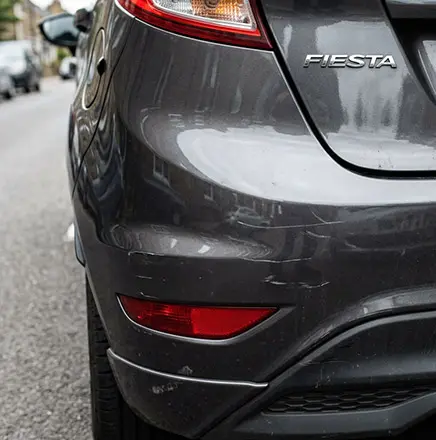
In general, Ford paint repairs are very DIY-friendly with Chipex, especially for everyday colours like Frozen White, Panther Black, Magnetic Grey, Moondust Silver, and Race Red. As long as you follow the instructions carefully, most standard Ford finishes blend cleanly when repaired properly.
The main exceptions tend to be tri-coat finishes, pearl paints, and certain performance colours, where matching and application can be a little more involved.
Managing Tri-Coat and Pearl Coats
Some Ford special-edition finishes, including Nitrous Blue (Focus RS Mk3), Diamond White pearl and certain Mustang colours, use tri-coat or pearlescent finishes.
While these colours can still be matched by Chipex, the DIY process is a bit more involved than a standard solid or metallic paint. This is because tri-coat systems usually require multiple paint layers, rather than a single application, so it’s important to follow the instructions very carefully.
What to Expect With Aftermarket Repaints and Previous Repairs
Another thing worth keeping in mind with older, used Fords is that the paint on the car may not always match the factory sticker.
Previous owners sometimes respray panels after accident damage, scuffs, or age-related wear, and sometimes this resprayed paint is occasionally in a slightly different shade. If the colour on your vehicle looks noticeably different from the sticker information, it’s still best to order using the original Ford paint code, but be aware that previous repairs can affect how well the new paint blends.
Get Your Ford Looking Its Best Again With Chipex
Ford paint matching doesn’t have to be complicated. In most cases, the hardest part is simply finding the right code in the first place. Once that’s sorted, most everyday colours are usually straightforward to repair at home with a little patience and the right approach.
Ready to finally fix that chip, scratch, or scuff on your Ford? Chipex makes it easy to get a clean, colour-matched repair at home. Find your perfect Ford paint match and shop our beginner-friendly touch up kits today!

Johnny Graham – Founder of Chipex
Johnny founded Chipex in 2009 and developed its patented paint repair system, now trusted by over 1.5 million customers worldwide. With nearly four decades at the premium end of the automotive industry, he remains closely involved in refining Chipex’s paint formulations and colour-matching technology.


