
A stone pings off the bonnet on the motorway, you spot the chip a week later in bright sun, and your mind jumps straight to a painful bodyshop bill. On a standard BMW colour, it rarely needs to. A stone chip is one of the simplest repairs there is, and you can get a near-perfect finish yourself on the driveway for a fraction of what a bodyshop charges to spray the panel. Near-perfect meaning you will know exactly where the chip was, but nobody else ever will.
It all comes down to one thing: matching your exact BMW paint code. Get that right and the repair disappears into the paint. So that is where we start, then we will walk through the repair, then go model by model, since BMW hides the code in different spots depending on what you drive.
Repairing the Chip, Step by Step
Once your colour is matched, the repair on a standard gloss BMW comes down to four stages:
- Clean and dry the chip. Wash the area and wipe away any wax, polish or road film, since fresh paint will not grip a dirty or greasy surface.
- Apply the colour-matched paint. Work it into the chip in thin layers rather than one thick blob, letting each layer firm up before adding the next until it sits level with the surrounding paint.
- Blend the repair flush. Feather the new paint into the surrounding panel so it sits level rather than proud, lifting away any excess so there is no visible ring around the chip.
- Polish back to the shine. Bring the repaired area up to the same gloss as the rest of the panel so it catches the light exactly like the paint around it.
That is the whole method on a standard gloss colour. For the complete walkthrough with every stage explained in full detail and pictures of each step, our stone chip repair guide covers everything you need to know and more.
Model-by-Model Notes
BMW is unusual in moving the paint code sticker around across its range, so where you look depends on which BMW you drive. Here is where the code tends to sit, along with the models UK owners are most likely to be running.
1 and 2 Series. The 1 Series was BMW’s best-selling model in the UK in 2025, with over 20,500 registrations according to BMW Group UK, so this is one of the most common BMWs on our roads. The paint code is generally found on the engine bay, so lift the bonnet and look there first. As with any hatchback, chips gather on the bonnet leading edge and front bumper.
3 and 4 Series. The 3 Series is BMW’s biggest-selling model line worldwide and a long-standing UK favourite, which makes it the car many readers here will own. Look for the code on the engine bay. Bonnet and front bumper are the usual chip zones over motorway miles.
5, 6 and 7 Series. These larger saloons also carry the code on the engine bay. Their longer bonnets present more surface to motorway debris, so they tend to collect chips across the front edge over time.
X1, X3, X5 and the X range. The X range is growing fast in the UK, with the latest X3 seeing a sharp rise in registrations. On these, the code sits inside the engine compartment or on the driver’s door shut. SUVs catch chips low down, around the front bumper and the wheel arches, where the tyres throw grit up.
Z3 and Z4. These sit in the engine compartment or on the door shut, depending on the age of the car.
M cars (M2, M3, M4, M5). Usually the engine bay, in line with the standard cars of the same era. M cars are more likely to wear Individual or exclusive colours, so confirming the exact code matters even more here.
Reading the BMW Sticker
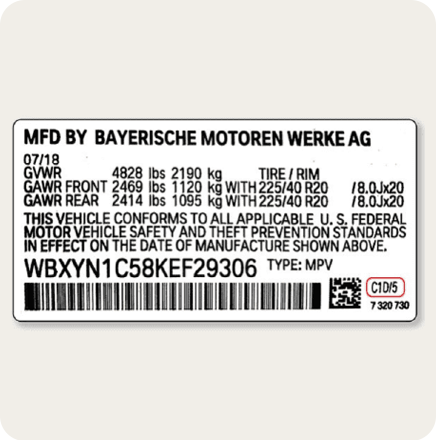
Once you have found the sticker, it helps to know exactly what you are looking at, because it carries several codes at once.
Look to the bottom left-hand corner, where you will find the paint code. It is a three or four character code, sometimes digits only like 300 for Alpine White, sometimes a letter followed by two or three characters like B45 for Estoril Blue. It can also be found on the bottom right of the sticker.
The colour name is very often printed in both English and German, so seeing Estorilblau next to Estoril Blue, or Alpinweiß next to Alpine White, is entirely normal for BMW and not a sign that anything is wrong. Match from the code rather than the name wherever you can, since similar names recur across model years and finishes.
The quickest alternative to reading the sticker is to find your colour with our reg-based match tool. Enter your registration and it returns the exact BMW paint code for your car, taking you straight to the matched paint.
If You Own an Older or Classic BMW
BMW has some of the most iconic older cars on the road, from the E30 3 Series to the E39 5 Series and the classic Z3, and plenty of them are still cherished and driven in the UK. If you own one, the repair approach shifts slightly.
Finding the code is the first difference. Older BMWs almost always keep the paint code on the engine bay strut tower rather than the door, so that is where to look, a black sticker with white lettering. If decades of heat and grime have left it faded or gone, the service booklet often records the original code, and failing that a BMW dealer’s parts department or our registration lookup can confirm it from the car’s details.
The repair itself deserves a little more care on an older car for two reasons. First, years of sun exposure tend to oxidise and fade the original paint, so even a perfect code match can look slightly brighter than the surrounding panel until you polish the old paint back to life first, then blend the repair into it. Second, and more importantly, rust is a real risk on older bodywork. A chip that has reached bare metal on a modern car is a problem within days, and on an older car with any existing corrosion nearby it is more urgent still. Catching and sealing chips promptly is the single best thing you can do to keep a classic BMW’s bodywork sound, so it is worth checking the usual chip zones regularly and dealing with anything down to metal quickly.
Special BMW Finishes Worth Knowing About
Two BMW finishes change how you approach the repair, and it is only fair to be upfront about both.
Frozen matte colours, like Frozen Grey and Frozen Black, are matte rather than gloss and behave completely differently. A standard gloss touch-up will not match a matte panel, and polishing a matte finish is the wrong move, since it brings up shine where there should be none. If your BMW wears a Frozen colour, and you decide to use a Chipex kit do not polish the paint after blending.
BMW Individual colours are special-order paints with their own codes that sit outside the standard catalogue. If your code does not appear in the usual list, an Individual colour is the most likely reason, and our reg lookup will confirm it.
Common BMW Colours
The BMW colours owners search for most, with codes confirmed from our own BMW colour database. Because BMW uses several codes for the same colour across years and markets, more than one code is listed where that applies.
| Code(s) | Name | Type | Notes |
| 300 / U300 | Alpine White | Solid | Classic BMW non-metallic white |
| 475 / B11 / C4R | Black Sapphire | Metallic | Most common BMW black |
| C4S / X10 / C3Z | Tanzanite Blue | Metallic | Premium dark blue |
| B45 / WB45 | Estoril Blue | Metallic | M and sport models |
| C36 / WC36 | Dravit Grey | Metallic | Modern BMW grey |
This is only a handful of the most-searched shades, and whatever colour your BMW wears, we guarantee you will find it on our BMW touch up paint page. Once you have your code, we have made the rest easy: pick your colour and you can order a complete kit built around it, with the exact matched paint and everything else you need to make the repair in one go.
A Couple of Other Things Worth Knowing
Two more situations come up often on BMWs.
Imported BMWs can carry codes that vary by market or fall outside the standard UK catalogue. Our reg look up should have the answer or ask your dealer.
Resprayed used BMWs are common enough to flag. The sticker records the factory paint, so if the car has been resprayed, the current panels may not match what the sticker says. Confirm the colour actually on the car before ordering.

Johnny Graham – Founder of Chipex
Johnny founded Chipex in 2009 and developed its patented paint repair system, now trusted by over 1.5 million customers worldwide. With nearly four decades at the premium end of the automotive industry, he remains closely involved in refining Chipex’s paint formulations and colour-matching technology.


