
Spot a fresh scratch on your car and the first question is always the same. What is this going to cost me? The honest answer is that car scratch repair cost in the UK ranges from under £20 to several thousand pounds, and the gap between those two numbers comes down to how you fix it, not just how bad the damage is. The same scratch can cost £40 on your own driveway or £300 at a bodyshop, depending entirely on the route you take.
So we will skip the long preamble and lead with the figures. Here are the typical UK price ranges for 2026, from the cheapest fix to the most expensive.
Car Scratch Repair Cost UK: 2026 Price Table
| Repair method | Paint pen | Typical UK cost (2026) |
|---|---|---|
| DIY scratch removal compound | Clear coat only, no colour loss | £13.95 to £19.95 |
| DIY touch-up paint kit | Chips and scratches through the paint | £39.95 to £46.95 |
| Mobile SMART repair | Localised scratch or scuff, one area | £50 to £300 per area |
| Bodyshop scratch repair (polish-out) | Clear coat scratch buffed out | £80 to £150 a panel |
| Bodyshop scratch repair (through paint) | Repainting a localised area | £60 to £300 a panel |
| Bumper respray | Full bumper refinished | £150 to £400 |
| Single panel respray | One door, wing or bonnet | £350 to £600 |
| Full car respray | Whole vehicle | £1,500 to £5,000+ |
A few notes before the detail. All of these are ranges, not fixed quotes, and the right number for you depends on the variables we cover further down. Bodyshop and respray figures draw on UK trade data from Checkatrade and Bumper, while the DIY kit pricing reflects current Chipex kit prices. Prestige, metallic and pearlescent finishes push the higher figures up further, as do larger vehicles and main-dealer bodyshops.
The pattern is already clear from the table. The further down the list you go, the more you are paying for labour, paint volume and time, rather than for the size of the original scratch.
Cost by Repair Method
It helps to understand what each option actually buys you, because the names get used loosely.
DIY repair means doing it yourself with a compound or a colour-matched kit. A compound only works on clear-coat scuffs that have not removed any colour. Once the scratch has gone through to the paint, you need a touch-up kit with matched paint, blending solution and polish.
A Chipex kit sits in the £39.95 to £46.95 bracket depending on size, and one kit covers many repairs rather than a single scratch.
SMART repair stands for Small to Medium Area Repair Technology. A mobile technician comes to you and refinishes a localised area rather than a whole panel, typically charging £50 to £300 per area. It sits between DIY and a full bodyshop visit on both cost and convenience.
Bodyshop scratch repair covers everything from machine-polishing a clear-coat mark out at £80 to £150 a panel, up to repainting a localised area through the paint at £60 to £300 a panel. The wide range reflects how much the panel, paint type and location move the figure.
Panel respray means refinishing a complete panel rather than spot-repairing it. A bumper runs £150 to £400 and a single door, wing or bonnet £350 to £600. Bumper data puts a single panel or bumper at the £250 to £400 mark, which sits squarely inside those ranges.
Full respray is the whole car, from around £1,500 for a small standard-colour vehicle up to £5,000 or well beyond for prestige and pearl finishes. This is rarely about a single scratch and almost always about age, fading or a colour change.
Cost by Damage Depth
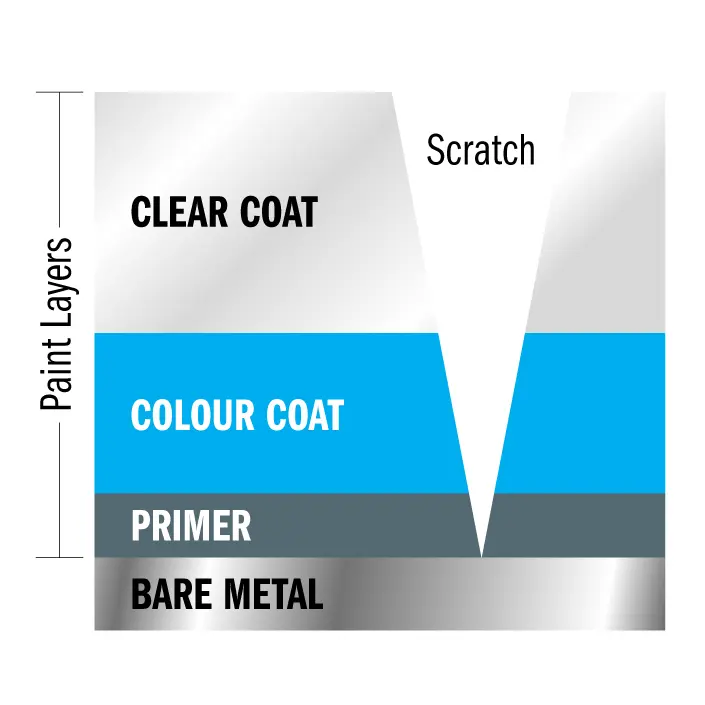
Depth is the other axis that decides the price, because each layer you break through adds labour.
A clear-coat-only scratch, where your fingernail glides straight over it, is the cheapest. It can often be polished out with a compound at home, or buffed out at a bodyshop for £80 to £150.
A scratch through to the base coat, where you see a colour change but no grey or silver, needs colour-matched paint. This is the classic DIY kit job, and it is also where a bodyshop starts charging for paint and blending, £60 to £300 depending on the panel.
A scratch through to the primer, showing grey, white or black at the bottom, needs paint built up in layers. Still a DIY job at home, still a localised repaint at a bodyshop.
A scratch through to bare metal, where steel is showing, needs sealing quickly because exposed metal corrodes. It needs primer first, then colour, then polish. At home that is a kit plus a small primer pen. At a bodyshop it pushes toward the top of the scratch-repair range or into respray territory.
A dented or creased panel is a different job entirely. Paint cannot reshape metal, so this is panel-beating work and the figures move well beyond the table above.
Cost by Panel
Where the scratch sits matters as much as how deep it is, because panel size drives paint volume and masking time.
Smaller panels like a door or wing sit at the lower end of respray pricing, roughly £350 to £450. Bumpers are their own category at £150 to £400, partly because they are plastic and prep differently. Larger panels like a bonnet or a full side run higher, £400 to £600 and up. Roofs and multi-panel damage climb fastest of all, because the work compounds across each surface.
This is the first place the DIY case quietly makes itself. A touch-up kit costs the same whether it is going on a Fiesta door or a Transit panel. The bodyshop quote does not work that way.
What Pushes a Bodyshop Quote Up
Two people with an identical scratch can be quoted very different numbers. A bodyshop quote is rarely pricing the damage on its own. It is pricing the panel, the paint, the vehicle and the location around it.
Paint type is the big one. Metallic, pearlescent and tri-coat finishes need multiple layers and far more care to match, which adds labour to every quote. Standard solid colours are the cheapest to refinish.
Panel size follows close behind. A larger panel means more masking and more paint, so the same chip on a Ranger, a Transit or a sizeable SUV can quote at close to double the same chip on a small hatchback, even when the damage itself is identical.
Damage depth adds a layer of labour at each stage, as covered above. Clear-coat, through-to-paint and through-to-metal each step the price up.
Bodyshop tier and region shift things too. Main dealers tend to sit at the top end, independents lower, London and the South East often run noticeably above the rest of the country for the same work.
Vehicle complexity is the modern wildcard. Panels carrying cameras, parking sensors or ADAS hardware can need recalibration after refinishing, and that cost lands on top of the paintwork.
The thing to take from this section is simple. The larger the vehicle and the more complex the paint, the wider the gap between a bodyshop quote and a DIY kit becomes, because the kit price never moves while the quote climbs with all of the above.
The Hidden Costs That Do Not Appear on a Quote
A written quote rarely tells the whole story. A few costs sit just outside it.
Time off the road is the obvious one. A panel respray means a day or two without the car, longer for bigger jobs, and a courtesy car may or may not be included. SMART and DIY repairs largely sidestep this.
Insurance excess is the quiet one. On a standard policy the excess often exceeds the cost of a minor cosmetic repair outright, which can make a claim pointless before it even starts.
No-claims impact follows from that. A claim can affect your no-claims bonus for several years, and the raised premiums over that period frequently cost more than simply paying for the repair yourself.
The cost of doing nothing is the one people forget. A scratch that has reached metal can rust, and rust spreads and devalues the car at resale, often by far more than the repair would have cost in the first place.
Insurance: The Neutral View
A quick, careful word on insurance, because the framework matters more than any single recommendation. In most cases, claiming on a standard car insurance policy for a minor cosmetic scratch is a poor financial choice, once the excess and the knock to your no-claims bonus are added up. Cosmetic or “scratch and dent” cover is a separate product that typically does not affect a standard no-claims bonus, so it sits in a different category entirely. Policy terms vary, so treat this as a way to think it through rather than a fixed rule, and check your own documents before deciding.
Where DIY Genuinely Saves Money
For most everyday damage, doing it yourself is simply the sensible option, and the table above shows why without anyone having to oversell it. The DIY case is strongest for:
-
- Stone chips and short scratches, the most common damage by far, where a kit handles the job in minutes of hands-on work.
-
- Multiple small chips across one panel, since a single kit covers many repairs rather than charging per chip the way a bodyshop effectively does.
-
- Older cars where resale value is not the priority and a near-invisible home repair is more than enough.
-
- Drivers who would rather sort it on the driveway than lose a working day to a bodyshop for a result they could achieve themselves.
The appeal is not just the headline price. It is that a £39.95 to £46.95 kit replaces a £150 to £600 bodyshop visit for the kind of damage most cars actually pick up, and there is paint left over for the next chip. The colour match is what makes that result hold up, which is why ordering against your exact factory paint code matters more than any other single step.
The easiest way to get it spot on is to find your colour with our reg-based match tool, which pulls your exact factory paint in seconds so there is no hunting for codes.
Where a Bodyshop Is Genuinely the Right Call
Unfortunately, DIY does not get the job done every time. There are cases where a bodyshop is simply the right call, and it is only fair to be upfront about them:
-
- Dented or creased panels, because paint cannot reshape metal and that is panel-beating work.
-
- Lease vehicles facing end-of-contract charges, where a professional finish protects you against inspection penalties that can dwarf the repair cost.
-
- Rust that has spread past the surface stage, showing as bubbling or flaking rather than a clean groove, which needs cutting back properly.
That is close to the whole list. For everything else, the cost comparison speaks for itself.
Real-World Scenarios: What You Would Actually Pay
Figures in a table are one thing. Here is how they play out on real cars.
A light key-mark on a small hatchback, clear coat only. Your nail glides over it. A DIY compound at £13.95 to £19.95 lifts it out, or a bodyshop polish-out runs £80 to £150. Easy DIY territory.
A deep scratch through to metal on a metallic mid-size wing. This needs sealing, priming and matched paint. A DIY kit with a primer pen comes to around £45 to £55 all in, a SMART repair £50 to £300, or a bodyshop respray £350 to £450. The metallic paint pushes the bodyshop figure up but does not change the kit price.
A multi-panel scratch down the side of a premium SUV with pearl paint. Multiple large panels, a complex finish and possible sensor recalibration. This is bodyshop territory, comfortably £600 and up, and not a sensible DIY job.
Multiple stone chips scattered across a dark bonnet. One Chipex kit handles the lot in a single session for £39.95 to £46.95, against a bodyshop bonnet respray of £400 to £600. The clearest DIY win on the list.
These are illustrative rather than guaranteed quotes, but the shape holds across all of them. The simpler and more common the damage, the more lopsided the cost comparison becomes in favour of doing it yourself.
Search by using your Registration
Frequently Asked Questions
How much does it cost to repair a car scratch in the UK?


Is it cheaper to repair a car scratch yourself?
How much does a bodyshop charge to fix a scratch?
How much is a SMART repair for a scratch?
Does car insurance cover scratch repair?
Will a DIY scratch repair look as good as a professional one?

Johnny Graham – Founder of Chipex
Johnny founded Chipex in 2009 and developed its patented paint repair system, now trusted by over 1.5 million customers worldwide. With nearly four decades at the premium end of the automotive industry, he remains closely involved in refining Chipex’s paint formulations and colour-matching technology.


