

If you had to guess the most popular car colour in the UK, you would probably picture the nation’s car parks and land on the right answer: grey. According to the latest figures from the Society of Motor Manufacturers and Traders (SMMT), the authoritative source for UK registration data, grey was Britain’s favourite new car colour in 2025 for the eighth year running, with a record 558,050 registrations. That is more than a quarter of every new car sold. Below we break down the full national top ten, the stories moving the numbers, and what your colour choice means when it comes to keeping the paint looking its best.
The UK’s Top Car Colours in 2025
Here is the national picture, straight from the SMMT’s 2025 new car registration data, published in early 2026.
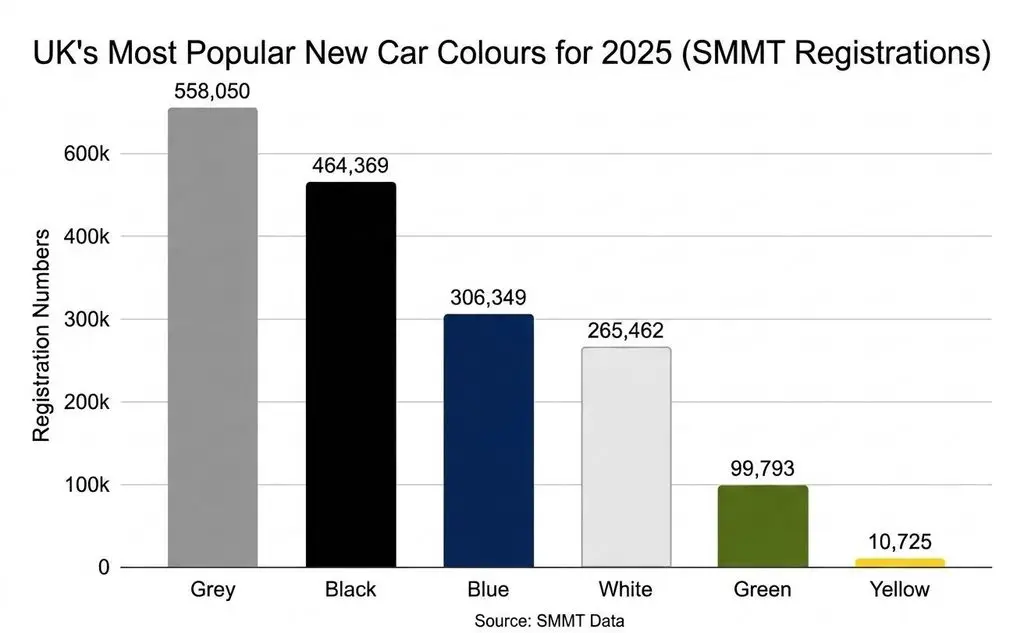
The single most striking figure is right at the top. Grey, black and blue together made up 65.8% of all new cars registered in 2025, nearly two thirds of the market in just three understated shades. Out of a total of around 2.02 million new cars, Britain overwhelmingly chose to blend in rather than stand out.
The Stories Inside the Numbers
A ranking is one thing, but the movement behind it is where it gets interesting.
Green is having a moment. The standout performer of 2025 was green, up 46.3% to 99,793 registrations, its best year since 2004. The reason is electric. Green battery electric car registrations nearly doubled to 23,249, meaning one in twenty new EVs was green, against roughly one in three hundred the year before. Models like the Renault 5 E-Tech, which offers green as its signature no-cost colour, and the Kia Sportage, the most registered green car of the year, are quietly rehabilitating a colour that had been out of fashion for two decades. And if you drive one of these less common shades, matching it for a repair is no harder than matching grey, our colour-match tool finds the exact factory code whatever the colour.
Britain’s monochrome habit runs deep. Grey, black, white and silver continue to dominate, and the reasons are practical rather than passionate. Neutral shades hold their resale value, date less obviously, and are the safe pick on a lease or finance car where an unusual colour can make handback and resale harder. It is telling that grey led almost every market segment and powertrain, the default choice of a nation that treats a car as an appliance as much as an expression. Part of the appeal is practical too, since neutral shades hide swirls and light scratches well, and keeping any colour looking its best comes down to good habits, which our guide on protecting your paint from stone chips runs through.
Red’s long fade continues. Once a mainstay of British driveways, red slipped 14.5% and was knocked out of the top five altogether by a resurgent silver, the first time silver has been back in the top five in nearly a decade. It is a quiet changing of the guard among the mid-table colours.
The rarities are gloriously rare. At the other end, boldness is vanishingly uncommon. Just 12 turquoise cars were registered in the entire country, a 96.7% collapse, and maroon, pink and turquoise combined managed only 342 between them. Curiously, cream bucked the trend, surging 741.6% to 3,215.
Taste splits by class of car. While grey led overall, the picture shifted at the extremes. Buyers of executive cars and luxury saloons preferred black, the mini segment leaned blue, and plug-in hybrids were most often specced in black, while battery electric buyers still mostly chose grey, 131,984 of them.
Some Colours Hide Scratches, Others Show Everything
Colour is not only about taste, it changes how a car wears, which is squarely our area as paint specialists. It is worth knowing before you buy, and useful whatever is already on your driveway.
Popular greys and silvers are quietly brilliant at hiding light swirls, road film and the odd fine scratch, which is a real part of their appeal and one reason they age so gracefully. Black, by contrast, looks superb freshly cleaned but shows every mark, swirl and speck of dust, which is why black owners tend to reach for a repair kit sooner than most to keep that showroom look. Whites are hugely popular and easy to live with, though the premium pearl and multi-coat whites are more involved to repair than a simple solid, since they are built up in layers.
Whatever colour you drive, what keeps it looking its best is dealing with chips and scratches promptly and matching them to the exact factory shade. A popular colour being common does not make it any easier to match by eye, and a rare one is not a lost cause, both come down to the precise paint code. When a chip does happen, our stone chip repair guide walks through sorting it neatly at home, from the commonest grey to the rarest turquoise.


